
The tournament
Australs has run every year since 1975, hosted by universities across Australasia and Asia. In 2027 it comes to New Delhi, the first time India has hosted it.
- Dates
- 27 June – 4 July 2027
- Venue
- IIT Delhi, New Delhi
- Format
- Australasian, three a side
- Speech length
- 8 minutes, 4-minute reply
- Preliminary rounds
- Eight
- Adjudication core
- Pranav Kagalkar, Ally Pitt, Sunghyun Park
Australs
The university debating championship of Australasia and Asia, held every year since 1975.
Teams of three come from across Australasia, South Asia and East Asia. They debate eight preliminary rounds over a week, and the best teams go through knockout rounds to a grand final.
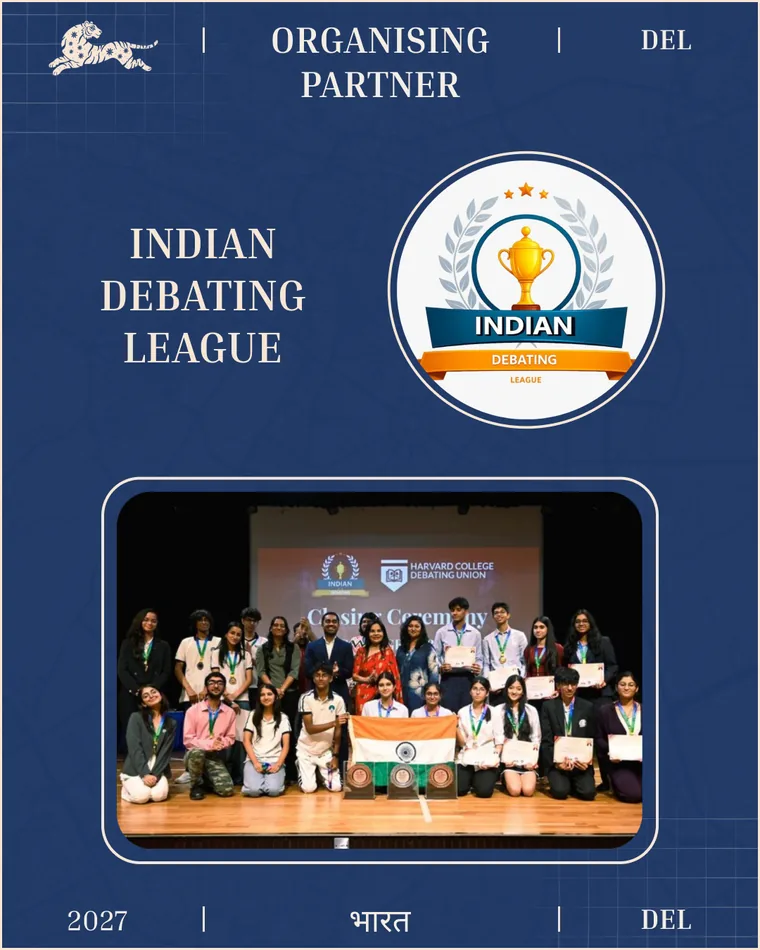
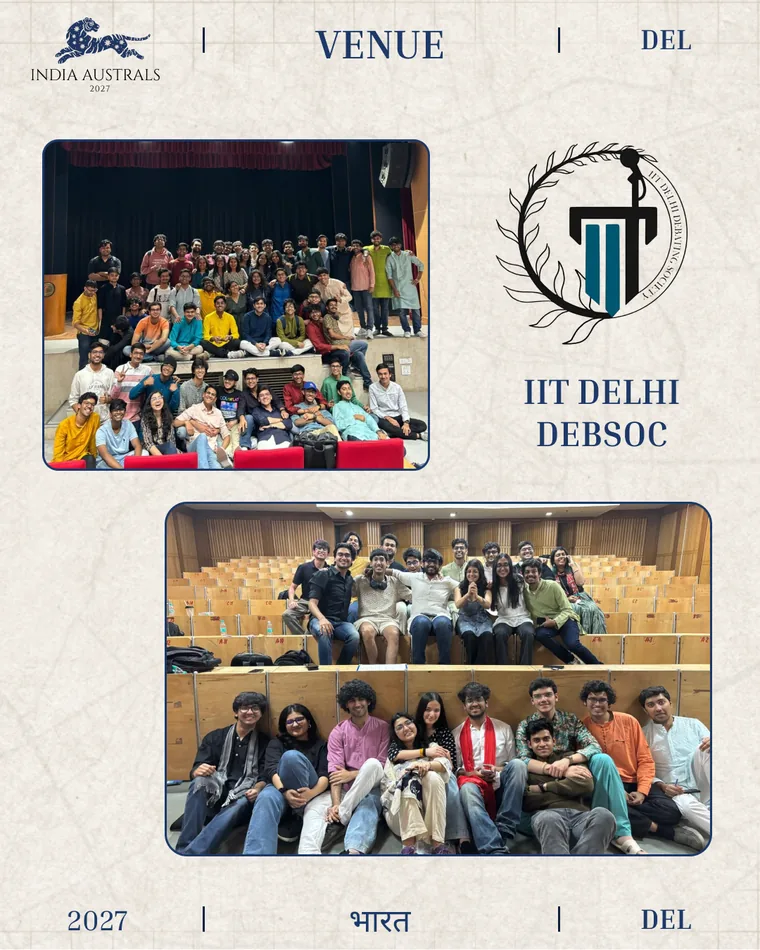
It has been to Sydney, Manila, Kuala Lumpur, Auckland, Kathmandu and Kuantan, but never to India. The Indian Debating League and the IIT Delhi Debating Society are hosting it. The three chief adjudicators come from India, Australia and South Korea.
Between them they have judged Worlds finals, chaired a UADC final and run the Australs tab. Each person's record is on their own page.
Since 1975
A different host each year, chosen by bid.
Australs started as a tournament for Australia and New Zealand. Over five decades universities from Indonesia, the Philippines, Malaysia, Singapore, Japan, Korea, India, Sri Lanka, Bangladesh and Nepal joined.
That is why the tournament has more than one break. Teams debating in a second or foreign language (ESL and EFL) compete in the open rankings and also against each other.
A debating society bids to host, and the winner has about two years to prepare. Delhi won the bid for 2027.
What hosting means
The format
Read this if you have only debated British Parliamentary.
Australs uses the Australasian format: two teams of three, Affirmative against Negative. There are six eight-minute speeches, alternating sides, then a four-minute reply from each team, given by its first or second speaker. The Negative replies first.
With only two teams in the room, you answer the other side directly. Your case builds across three speakers, and the reply speech sums up the debate without adding new arguments.
Every motion is released thirty minutes before the round. See rounds and the break.
A round, in order
- 1st Affirmative8 minDefines the motion and opens the case
- 1st Negative8 minAnswers the definition, opens the opposing case
- 2nd Affirmative8 minRebuts, extends
- 2nd Negative8 minRebuts, extends
- 3rd Affirmative8 minRebuttal, no new matter
- 3rd Negative8 minRebuttal, no new matter
- Negative reply4 minWeighs the debate. 1st or 2nd speaker
- Affirmative reply4 minWeighs the debate, last word
Rounds and the break
Eight preliminary rounds, then knockout rounds for the teams that break.
There are eight preliminary rounds. Each motion comes out thirty minutes before the round: you get five minutes to choose a motion and twenty-five to prepare. We release no motions in advance.
There will be an Open break. We will also run ESL and EFL breaks if enough teams hold each language status to meet the constitution's minimum. A Language Team decides each team's status, and you can apply for one closer to the tournament.
We will post the day-by-day schedule on the schedule page closer to the tournament.
The network
Nineteen advisors in eighteen countries, across five regions. You can register from anywhere in the Asia Pacific, with or without an advisor in your country.
- IndiaSouth AsiaAayana Rai Bhojani
- Sri LankaSouth AsiaDaniel Victor
- BangladeshSouth AsiaSajid Asbat Khandaker
- NepalSouth AsiaSrijan Poudel
- PhilippinesSouth East AsiaBea Legaspi
- MalaysiaSouth East AsiaIan Dylan Chai, Patrick Cheang
- SingaporeSouth East AsiaIan Dylan Chai
- IndonesiaSouth East AsiaTengku Omar
- VietnamSouth East AsiaVũ Anh Tuấn
- MacauNorth East AsiaDonner Tang
- ChinaNorth East AsiaRicky Jin
- South KoreaNorth East AsiaYoungwoo Park
- JapanNorth East AsiaMinami Matsushima
- New ZealandOceaniaAisha O'Malley
- AustraliaOceaniaJordyn Gibson, Kat Cheng
- USABeyond AustralasiaJane Mentzinger
- ColombiaBeyond AustralasiaJuanita Hincapié Restrepo
- SerbiaBeyond AustralasiaMarta Vasić
Organisers
Two organisations run it together.
The Indian Debating League runs debating across Indian universities and schools, and has partnered with the Harvard College Debating Union on tournaments in India.
The IIT Delhi Debating Society hosts the tournament on campus and runs the day-to-day: the desk, the rooms and the socials.